What is Veeva Vault and How Is It Used for Data Integration?
Veeva Vault is a cloud-based content and data management platform designed specifically for the life sciences industry. Organizations use Veeva Vault to manage regulated documents, clinical content, quality records, regulatory information, and other business-critical data.
As life sciences organizations increasingly adopt modern data platforms, integrating Veeva Vault with systems such as Databricks, Snowflake, data lakes, APIs, and enterprise applications has become an important part of their data strategy.
What is Veeva Vault?
Veeva Vault is a cloud platform from Veeva Systems that provides applications for managing content, documents, processes, and information across the life sciences industry.
Depending on the business use case, Veeva Vault can contain information related to clinical trials, regulatory submissions, quality management, commercial content, safety processes, and controlled documents.
Because much of this information is business-critical and regulated, organizations need secure and controlled mechanisms to extract, transform, and integrate Vault data with their enterprise data platforms.
Why Integrate Veeva Vault with a Data Platform?
Veeva Vault is often one of several systems used by a life sciences organization. Important information may also exist in ERP systems, CRM platforms, laboratory systems, data warehouses, and cloud data platforms.
Data integration enables organizations to bring information from these systems into a centralized analytical environment.
Common objectives include:
- Centralizing enterprise and life sciences data
- Building analytics and reporting solutions
- Creating data lakes and modern data warehouses
- Combining Vault data with data from other enterprise systems
- Supporting regulatory and compliance reporting
- Enabling downstream machine learning and AI use cases
- Maintaining historical and incremental versions of data
How Does Veeva Vault Data Integration Work?
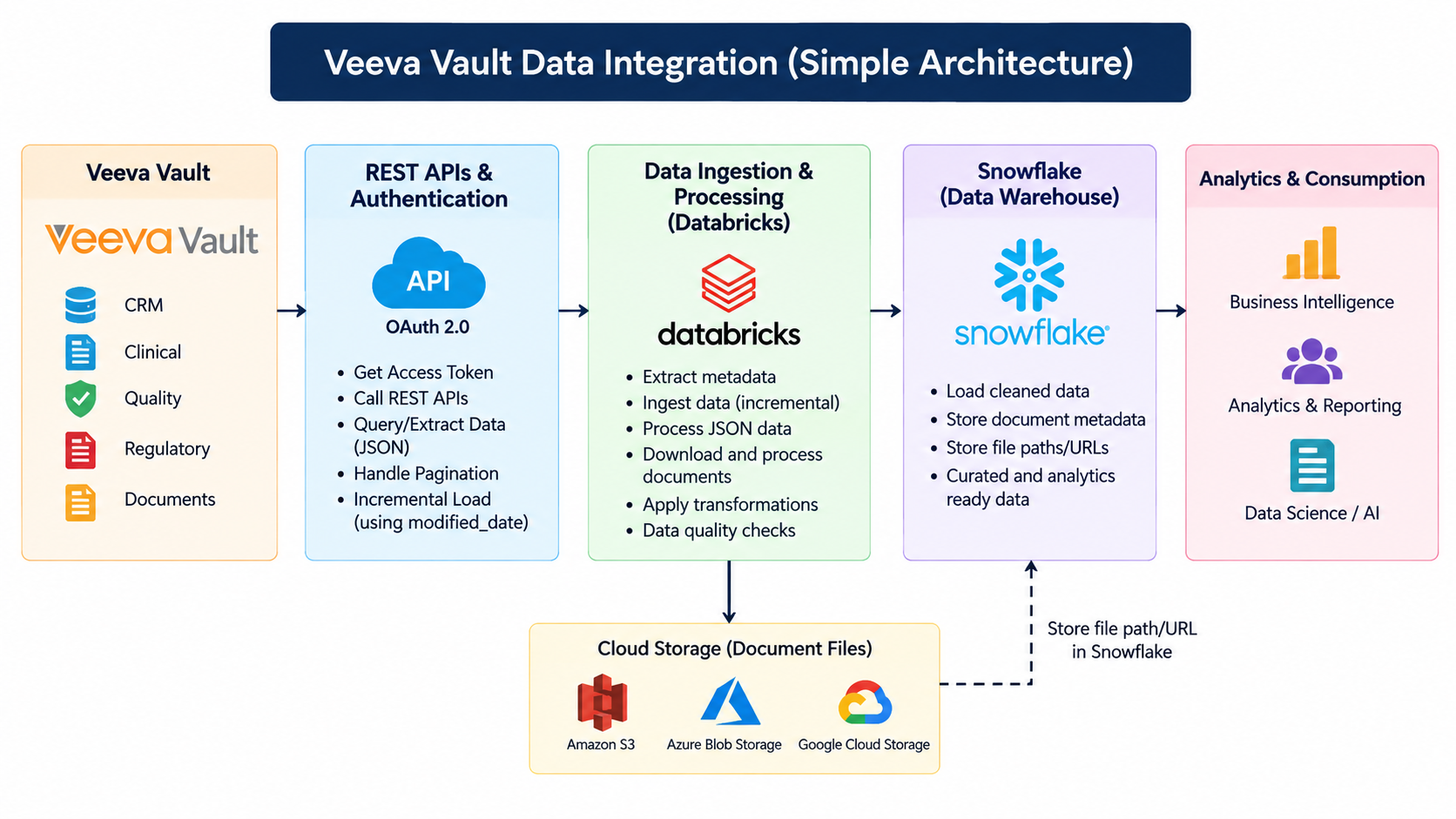
A typical Veeva Vault integration uses APIs to extract data and documents from Vault and then processes that information in a cloud-based data platform.
A simplified architecture can look like this:
                    VEEVA VAULT
                         |
                         | REST API
                         v
                  Authentication
                         |
                         v
                 Authorization Check
                         |
                         v
                    Metadata API
                         |
                         v
                  Databricks Job
                         |
              +----------+----------+
              |                     |
              v                     v
       Incremental Load       Document Download
              |                     |
              v                     v
       Bronze Delta Tables    Document Storage
              |                     |
              +----------+----------+
                         |
                         v
                  Silver Layer
                         |
                         v
                    Gold Layer
                         |
                         v
              Snowflake / BI / AI
1. Authentication
The first step in a Veeva Vault integration is establishing secure authentication between the integration platform and Vault.
The integration process should use the authentication mechanism supported by the organization's Veeva Vault configuration. Credentials, tokens, and other sensitive configuration values should be securely managed rather than hard-coded into application code.
2. Authorization and Access Control
Authentication confirms the identity of the integration process, while authorization determines what information it is allowed to access.
This distinction is particularly important in regulated life sciences environments. The integration account should have only the permissions required for the intended data extraction and processing activities.
3. Extracting Metadata
Veeva Vault provides APIs that can be used to access Vault information. Depending on the use case, an integration may retrieve document metadata, object records, relationships, classifications, versions, and other relevant information.
Metadata is particularly important because it provides context about the actual content. For example, a document record may contain information such as its identifier, type, status, version, lifecycle state, and other attributes.
4. Incremental Data Extraction
A production integration should generally avoid extracting the entire Vault dataset every time a pipeline runs.
Instead, an incremental strategy can identify newly created or modified records and process only the required changes.
For example:
- Identify records modified since the previous successful execution.
- Extract the changed metadata.
- Identify associated documents when required.
- Load the extracted data into the Bronze layer.
- Transform and validate the data in subsequent layers.
This approach can reduce processing time, API usage, and unnecessary data movement.
5. Document Download and Storage
Veeva Vault is not limited to structured metadata. Many business processes involve documents and content.
When documents are required for downstream processing, the integration pipeline can retrieve the appropriate document content through the supported Vault interfaces and store it in an appropriate cloud storage location.
A common architecture separates structured metadata from document binaries while maintaining a relationship between the two through a unique document identifier.
6. Processing Data with Databricks
Databricks can be used as the processing layer between Veeva Vault and downstream data platforms.
A Databricks job can perform tasks such as:
- Calling Veeva Vault APIs
- Processing incremental records
- Downloading required documents
- Validating incoming data
- Parsing and transforming structured data
- Writing data to Delta tables
- Maintaining audit and control information
Medallion Architecture for Veeva Vault Data
A Medallion Architecture can be used to organize Veeva Vault data into different processing layers.
Bronze Layer
The Bronze layer stores raw or minimally processed data received from Veeva Vault. This layer helps preserve the source representation and provides a foundation for reprocessing and auditing.
Silver Layer
The Silver layer contains cleaned, validated, standardized, and transformed data. Business rules and data-quality validations can be applied at this stage.
Gold Layer
The Gold layer contains business-ready datasets optimized for reporting, analytics, data science, and downstream applications.
Integrating Veeva Vault with Snowflake
Snowflake can serve as a centralized analytical data platform for Veeva Vault data. An organization may extract data from Vault, process it using a platform such as Databricks, and then publish curated datasets to Snowflake.
A typical flow can be represented as:
Veeva Vault
     |
     | REST APIs
     v
Databricks
     |
     | Delta / Transformation
     v
Curated Data
     |
     v
Snowflake
     |
     +---- BI & Reporting
     |
     +---- Data Science
     |
     +---- AI / ML
Key Challenges in Veeva Vault Data Integration
Building a reliable Veeva Vault integration requires more than simply calling an API. Several technical and operational considerations need to be addressed.
API Limits and Performance
Integration pipelines should be designed with API usage, pagination, retry handling, and appropriate request rates in mind.
Incremental Processing
The pipeline should maintain reliable watermarks or control information so that changes can be identified and processed without repeatedly extracting the entire dataset.
Document Versioning
Documents may have multiple versions and lifecycle states. The integration design should preserve the required version and metadata relationships.
Security
Sensitive credentials and tokens should be stored using secure secret-management mechanisms. Access to Vault and downstream data should follow the organization's security and compliance requirements.
Data Quality
Validation rules should be implemented to identify missing identifiers, unexpected values, duplicate records, incomplete metadata, and other data-quality issues.
Auditability
For regulated environments, maintaining appropriate logs and audit information can be important. A robust pipeline should record processing status, timestamps, record counts, errors, and other operational information required by the organization.
Best Practices for Veeva Vault Integration
- Use supported Veeva Vault APIs and integration mechanisms.
- Implement incremental rather than unnecessary full data extraction.
- Secure credentials using a secrets-management solution.
- Implement pagination, retry, and error-handling mechanisms.
- Maintain source identifiers and document relationships.
- Track document versions where required by the business process.
- Maintain ingestion and processing audit logs.
- Apply data-quality checks before publishing curated datasets.
- Separate raw, transformed, and business-ready data.
- Monitor API failures, pipeline failures, latency, and record counts.
Conclusion
Veeva Vault plays an important role in managing content, documents, and information within life sciences organizations. Integrating Vault with modern data platforms allows organizations to combine this information with data from other enterprise systems and make it available for analytics, reporting, AI, and data science.
A well-designed architecture typically combines secure API access, incremental extraction, document handling, Databricks or another processing platform, a medallion-style data architecture, and a cloud data warehouse such as Snowflake.
The result is a scalable and governed data pipeline that can move information from Veeva Vault into the broader enterprise data ecosystem while maintaining data quality, security, and traceability.
Explore Modern Data Integration with dbMetrik
At dbMetrik, we focus on modern data and analytics technologies, including Snowflake, Databricks, dbt, Coalesce, and Python. Understanding how enterprise applications such as Veeva Vault connect with modern data platforms is an important skill for data engineers, architects, and analytics professionals.